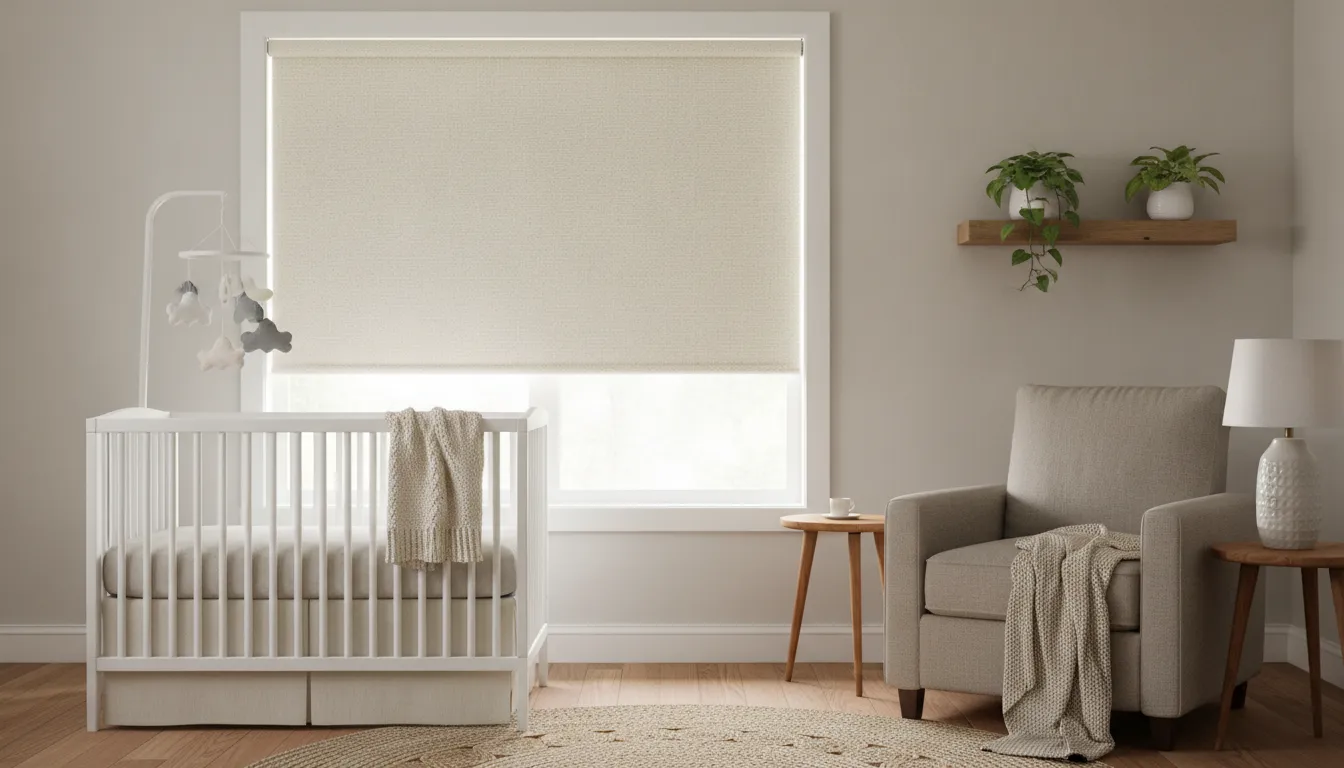
A nursery window has to do more than look finished. It needs to support naps, protect privacy, operate safely, and fit closely enough to manage unwanted light without creating new hazards. The right choice depends on the window, the room’s routine, and how the covering will be used every day.
Blackout blinds for nursery windows can help create a darker, calmer sleep space, but parents should compare light-control levels. Cordless or motorized operation, mounting style, and professional fit rather than choosing by the word “blackout” alone. Small gaps around the edges can still let light enter, and blinds and shades may offer different solutions.
Call Vineyard Blind & Shutter at (951) 757-4188 for a free in-home consultation and measuring.
Start by looking at the details that matter most in a nursery: how dark the room needs to be. Where the crib and furniture sit, how the covering will be controlled, and whether the installation suits the window. These considerations make it easier to compare options with safety and daily use in mind.
What should you look for in blackout blinds for nursery windows?
When comparing blackout blinds for nursery windows. Start with the result you need at nap time and overnight: dependable light control without creating new safety or maintenance concerns. “Blackout” and “room-darkening” are not interchangeable. Room-darkening treatments reduce incoming light, while blackout-level products are designed to block substantially more. Even a blackout-rated treatment can allow narrow beams around the sides, top, or bottom if the window covering is not fitted closely to the opening.
Check the darkness level and edge gaps
Look at the entire window, not only the blind material. Slats or fabric may block light across the center while small side gaps. An exposed top rail, or a gap below the treatment still lets morning sun into the room. Ask how the chosen product handles those areas and whether an inside or outside mount is better for the window trim. If the nursery faces an especially bright street or receives direct afternoon sun, bring that detail into the product discussion.
It is also useful to distinguish blinds from shades. Blinds typically use slats that tilt for privacy and light adjustment. Shades use a continuous material and may offer additional blackout constructions. If maximum darkness is the priority, compare both categories rather than assuming that every blind will perform like a blackout shade. You can review custom blinds and blind options before deciding which features matter most.
Prioritize cordless operation and practical cleaning
A nursery treatment should be easy to operate while keeping cords away from a child’s reach. Cordless lift is available for some faux wood blinds, and motorized controls are available across many product lines, but neither feature should be assumed. Confirm the exact configuration for the window treatment you select. The U.S. Consumer Product Safety Commission identifies cordless coverings as the safest option when young children are present, so cord safety deserves equal attention with color and style.
Consider how the blind will hold up to everyday nursery use. Smooth, durable surfaces are generally easier to dust and wipe than delicate textures. Ask about cleaning instructions, especially if the window is near a changing area, play space, or air vent that can move dust into the room. Choose a finish that works with the nursery, but do not sacrifice cleanability for appearance.
Confirm privacy, fit, and operation
During the day, parents may want filtered light and privacy without keeping the room completely dark. At night, they may prefer a closed treatment that limits views from outside. Check whether the slats, fabric, or control system allows that flexibility. Accurate measuring also matters for smooth operation and consistent coverage. A custom in-home measurement can identify trim, handle, and clearance issues before installation, helping you choose a treatment that fits the window and the nursery routine.
Why is cordless operation important in a nursery?
Darkness matters for naps, but safety should come first when choosing a window covering for a baby’s room. The U.S. Consumer Product Safety Commission identifies cordless window coverings as the safest option when young children are present. Accessible pull cords, continuous-loop cords, inner cords, and other window-covering cords can create an entanglement hazard. The CPSC notes that these incidents can happen in moments and are often silent, so supervision alone is not a reliable safeguard. Read the CPSC’s GoCordless guidance for its full recommendations.
When comparing blackout blinds for nursery windows. Look for products specifically labeled cordless rather than assuming that a blackout fabric or enclosed slat design automatically removes every cord hazard. Cordless faux wood blinds are one available option, and motorized controls are available across many blind and shade lines. However, these features are options, not a universal guarantee. Confirm the operating system, control location, and any accessible cords for the exact product selected.
What should you check before ordering?
- Choose a treatment labeled cordless whenever the room may be used by a child.
- Ask whether the product uses a cordless lift, motor, remote, or another control system.
- Check that the control method will remain out of a child’s reach during daily use.
- Confirm how the treatment operates before finalizing the order and installation.
If you already have corded coverings, replacement with a cordless product is the clearest option. Until replacement is possible, keep cribs, beds, furniture, and toys away from windows and cords, preferably on another wall. The CPSC also advises keeping cords out of children’s reach, shortening dangling pull cords, and installing cord stops correctly. For continuous-loop cords, anchor the cord to the wall or floor with appropriate fasteners, keeping it taut but still operable. These steps reduce exposure, but they should not be treated as a substitute for a properly selected cordless covering. The CPSC specifically warns that some retrofit kits do not address dangling pull-cord hazards.
A professional in-home consultation can help you compare cordless and motorized custom blinds and blind options alongside shades, while checking how each choice will function in the nursery. Vineyard Blind & Shutter provides measuring and installation, so the safety decision includes both the product and its finished setup.
Which window treatments balance darkness, comfort, and flexibility?
There is no single best window treatment for every nursery. The right choice depends on how much light the room receives, whether you need daytime flexibility, how the covering will operate, and how closely it fits the window. Product availability and real-world performance also depend on the selected material, mounting method, and installation quality.
It helps to separate three darkening levels: light-filtering, room-darkening, and blackout. Blackout blinds, blackout shades, and some lined designs can offer the strongest light control, but small gaps around the edges may still allow daylight into the room. The comparison below provides a practical starting point, not a guarantee of complete darkness. For a broader look at styles and light-control options, visit our custom shades page.
| Option | Light control | Comfort and flexibility | What to confirm |
|---|---|---|---|
| Blackout blinds | Can provide strong light control when the slats, material, and fit are selected for that purpose. | Adjustable slats can give parents control over privacy and daylight when the room is in use. | Ask about cordless operation, edge gaps, slat closure, and whether the design is intended to provide blackout-level control. |
| Blackout shades | Can reduce incoming light across the window surface, with results affected by the shade design and installation. | A smooth shade can create a simple appearance and may suit a nursery where easy daily operation matters. | Confirm the fabric, operating system, mounting position, and how the shade addresses light around the sides. |
| Cellular shades | Available in light-filtering, room-darkening, and blackout designs. | The cellular construction can provide some insulation, while the selected opacity determines how much daylight remains. | Choose the opacity and operation separately. A cellular shade is not automatically a blackout shade. |
| Lined or room-darkening designs | Some lined treatments and room-darkening products can provide substantial light reduction without using a dedicated blackout design. | They may offer a softer appearance or more daylight flexibility, depending on the fabric and construction. | Check the lining, fabric behavior, privacy level, and expected fading from direct sunlight. |
For nursery planning, light control should be considered alongside safe operation and a precise fit. A treatment that looks dark in a sample may perform differently once installed on a wider window or mounted outside the frame. Reviewing samples in the nursery’s actual light can make the tradeoffs easier to judge.
How do fit and installation affect light control?
Even well-designed window coverings can leave distracting brightness around the edges when the fit does not match the window. In a nursery, small details such as trim, handles, nearby walls, and the direction of operation can affect both darkness and daily convenience. A careful installation plan helps you choose the right approach without assuming that any one product will create complete blackout in every room.
Use these steps to evaluate the window before choosing between custom blinds and blind options or custom shades and light-control options:
- Compare inside and outside mounting. An inside mount sits within the window recess and can provide a clean, integrated appearance. An outside mount attaches above or around the opening and may cover more of the surrounding area. Which can help reduce visible side light when the recess is shallow or uneven. Trim, sill depth, handles, and nearby walls all matter when selecting the mount.
- Measure width and height at several points. Windows are not always perfectly square. Record the width and height in more than one location, then check the smallest dimensions for an inside mount and the surrounding wall space for an outside mount. Also note handles, locks, vents, radiators, and any feature that could interfere with the blind, shade, or operating mechanism.
- Check likely light gaps. Look at the space above the frame, along both side edges, and below the treatment. A close fit can improve darkness, but the result depends on the product design and installation. For especially light-sensitive sleepers, discuss whether a shade, lined treatment, or another design is more suitable rather than treating “blackout” as a universal guarantee.
- Choose an operation that fits the nursery routine. Cordless lift options are available for some products, including faux wood blinds, while motorized controls are available across many blind and shade lines. Confirm the exact operating system for the selected treatment, and consider how easily an adult can adjust it without moving furniture near the window.
- Have the installation professionally checked. Vineyard Blind & Shutter provides free professional measuring and evaluates inside- or outside-mount choices and structural considerations. Its mobile showroom brings samples into your home, so you can compare color, material, and light control in the nursery’s actual lighting. To schedule an in-home consultation or request measuring, contact Vineyard Blind & Shutter.
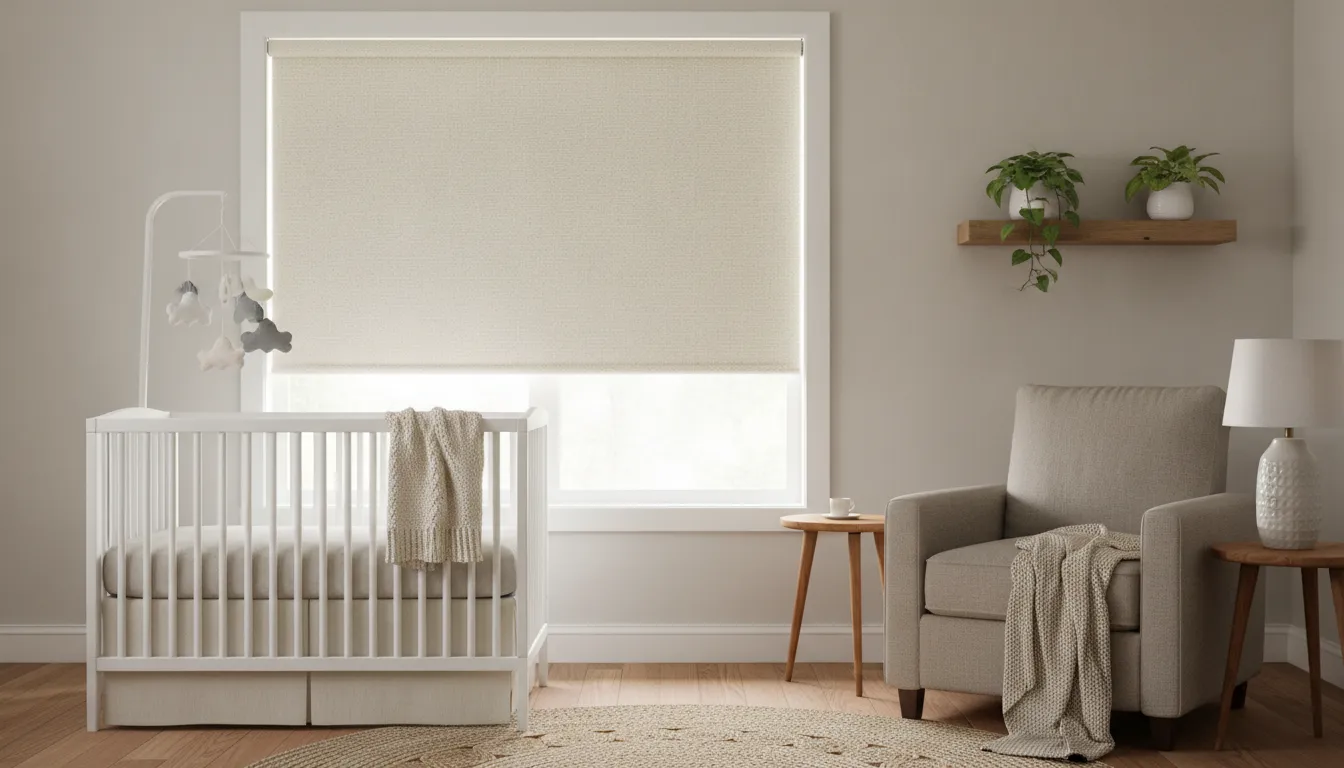
That in-home review is especially useful for parents comparing blackout blinds for nursery windows. Because it connects the product choice to the actual opening, surrounding trim, and bedtime routine.
How can parents create a safer, calmer sleep environment?
Window treatments can help parents manage changing daylight, but they are only one part of a nursery’s sleep environment. During the day, opening the covering lets natural light signal that it is daytime. Before a nap or nighttime routine, closing a room-darkening or blackout design can reduce bright light and make the room feel more consistent. That controlled transition may support a clearer day-night routine, but blackout blinds for nursery windows cannot guarantee that a baby will sleep longer or more soundly.
A 2024 scoping review found that environmental light exposure plays a role in establishing infant circadian rhythms. It also reported benefits from cycled lighting in the studies reviewed, including improved nighttime sleep and daytime wakefulness. However, the review included 25 studies and noted that experimental evidence was limited. So parents should treat light control as a practical routine-support tool rather than a sleep treatment. Read the PubMed review for the research context.
Separate window-covering safety from safe-sleep basics
A darker room does not make an unsafe sleep setup safe. The Safe to Sleep program says a baby’s sleep surface should be firm, flat, and level, covered only with a fitted sheet. Babies should not sleep alone or with others or pets on an adult bed, couch, or armchair. Soft items and soft sleep surfaces can increase the risk of SIDS and other sleep-related deaths. These recommendations apply regardless of whether the nursery has blinds, shades, curtains, or no window treatment at all. Review the Safe to Sleep guidance for the complete safe-sleep recommendations.
- Use window coverings to manage daylight and privacy, not as a substitute for safe sleep practices.
- Choose a cordless design when possible, and keep cribs, beds, furniture, and toys away from windows and window-covering cords.
- Check the room at different times of day so you can identify side gaps, glare, or direct sun without assuming the treatment creates complete darkness.
- Follow your pediatrician’s advice for your child’s individual sleep and health needs.
For families comparing blinds and shades, the right choice depends on the window, the desired level of light control, and how the covering will be operated. A careful measurement and a child-conscious installation plan can make the treatment easier to use while keeping the nursery’s essential safety practices separate and clear.
When should you choose custom nursery window coverings?
Custom nursery window coverings are especially worthwhile when the room has unusual window sizes. Strong afternoon sun, several windows with different shapes, or a routine that depends on flexible light control. A made-to-fit treatment can also help you think through practical details together, including the mounting position. Operating system, privacy needs, and the amount of light that may enter around the edges. Blackout performance depends on the chosen product and installation, so a consultation is a useful way to discuss expectations rather than assume every option will create identical darkness.
The decision is easier when you can see materials in the nursery itself. Vineyard Blind & Shutter brings its mobile showroom to your home, allowing you to compare samples in the room’s actual lighting and alongside the nursery’s colors and furnishings. A representative can explain the differences between custom blinds and blind options and custom shades and light-control options, including which cordless or motorized systems are available for the product you select.
Free professional measuring adds another layer of confidence. The visit can account for inside- or outside-mount choices, window conditions, and fit considerations before an order is placed. Professional installation then helps the treatment operate as intended, without leaving the measuring and fitting process entirely to guesswork. This can be valuable for parents preparing a nursery on a deadline or coordinating several rooms at once.
- Choose a consultation when light gaps, privacy, or window shape are difficult to evaluate from measurements alone.
- Ask which cordless or motorized control is available for the exact product under consideration.
- Bring up the nursery’s daily nap and bedtime routine so light control recommendations fit real use.
Vineyard serves homeowners in San Diego, Riverside, and Orange counties. You can schedule an in-home consultation or request measuring, then review the available Southern California service areas.
Frequently Asked Questions
What are the best blackout blinds for a nursery?
Choose a treatment that combines strong light control with a cordless design and a close, well-fitted installation. Blackout blinds can work well, but blackout shades or lined options may be a better match for the window, room style, and desired operation. Blackout does not always mean every edge will be completely dark, so ask how the mounting style and side gaps will affect the result.
Are blinds safe in a nursery?
They can be, when the window covering is cordless and installed correctly. The U.S. Consumer Product Safety Commission identifies cordless window coverings as the safest option when young children are present and advises keeping accessible cords out of reach. If an existing treatment cannot be replaced immediately, move the crib, furniture. And toys away from the window and cords, then discuss safer replacement options with a qualified installer. Source: CPSC GoCordless guidance.
Do babies need blackout blinds?
Not every baby needs a fully dark room, and a window treatment cannot replace safe sleep practices. However, reducing bright or inconsistent light can make naps and bedtime more comfortable. Research reviewed in 2024 found that environmental light exposure plays a role in infant circadian rhythms, while also noting that experimental evidence is limited. Use blackout as one part of a consistent routine, not as a guarantee of longer sleep. Source: 2024 scoping review.
How can I reduce light gaps around nursery blinds?
Start with accurate measurements and ask whether an inside or outside mount is better for the window. The installer should review the frame, headrail, mounting depth, and side gaps before ordering. A professional in-home measurement can identify fit issues that are easy to miss with basic tape measurements and help you compare cordless blinds, shades, and other light-control options.
Ready to Choose the Right Nursery Window Coverings?
A personalized review can help you balance darkness, cordless safety, fit, and everyday operation for your nursery. Call Vineyard Blind & Shutter at (951) 757-4188 to schedule a free in-home consultation and professional measuring.