Bay windows add architectural charm and natural light to any room, but finding window coverings that fit them well is a different challenge. The angled panels, varying depths, and unique shapes mean off-the-shelf options rarely work. You need coverings that match each panel while creating a cohesive look across the entire window.
Schedule a free in-home bay window consultation with Vineyard Blind & Shutter and see custom options in your own lighting. Call (951) 757-4188 to get started.
This guide breaks down the top bay window treatments, from plantation shutters and cellular shades to roller shades and vertical blinds. We cover what works, what to avoid, and why professional measuring makes all the difference for bay window installations in Southern California homes.
Why Bay Windows Need Special Window Treatments
Standard window coverings are built for flat, rectangular openings. Bay windows break that mold with three or more panels set at angles, usually 30 to 45 degrees from the wall. That creates several challenges most homeowners do not expect:
- Angled panels require individual measurements. Each section of a bay window can differ in width and depth by a quarter-inch or more. A covering that fits one panel may not fit the next.
- Mounting hardware must follow the angles. Brackets set for flat walls will not align with angled bay window frames. Custom mounting is often necessary.
- Light gaps appear at the joints. If coverings do not sit flush against each angled panel, light bleeds through the seams between sections.
- Weight matters more than usual. Bay windows often have wider spans than standard windows. Heavier treatments like wood blinds can sag or bow in larger panels.
Getting the fit right starts with accurate measurements for every panel. Even a small error means gaps, uneven lines, or coverings that will not operate correctly. That is why most window treatment professionals recommend an in-home measurement for bay windows specifically.
Plantation Shutters: The Top Choice for Bay Windows
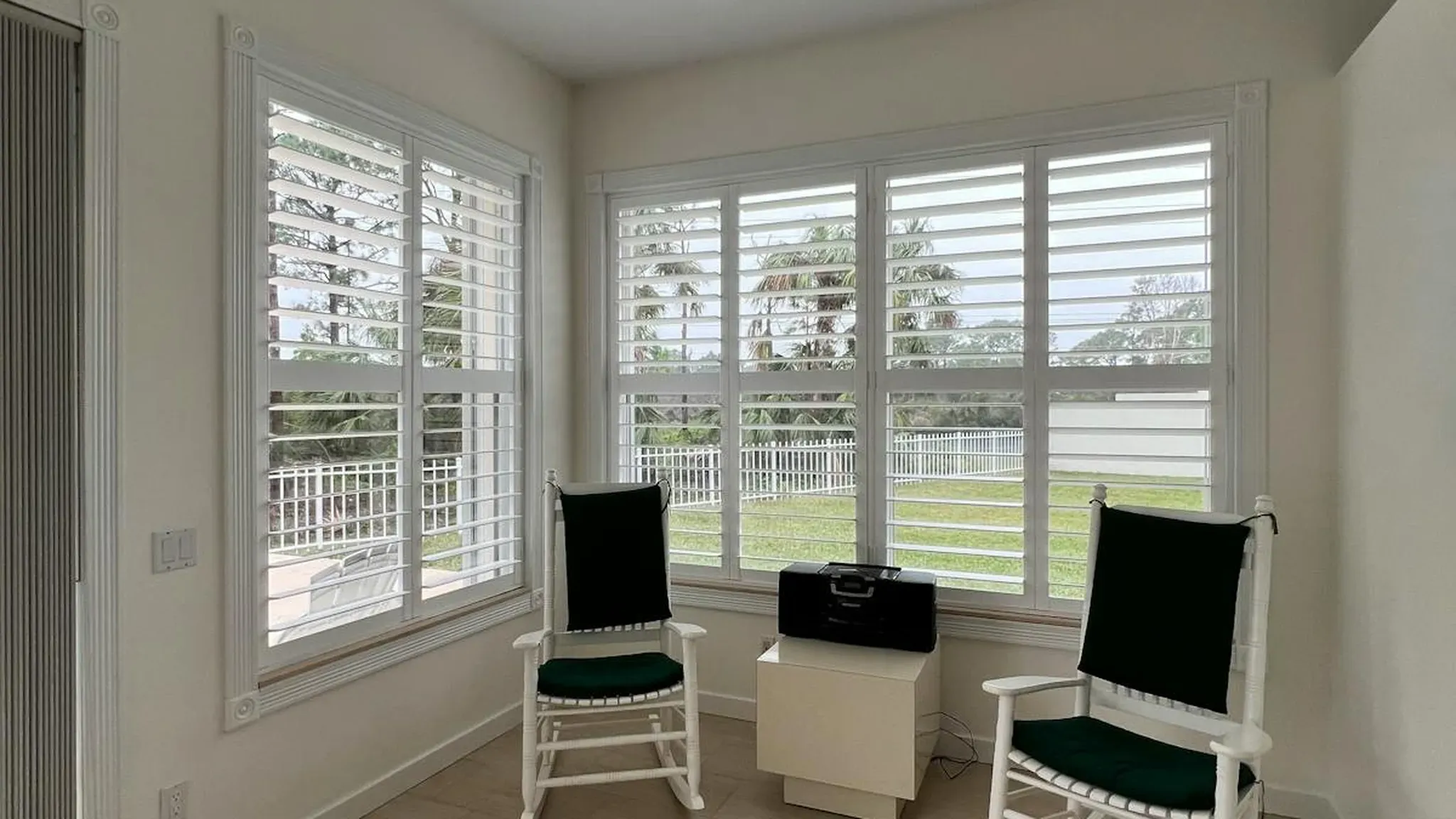
Plantation shutters are the most popular bay window treatment for good reason. They mount directly into each panel frame, follow the window angles precisely, and give you independent control over light and privacy in every section.
Why Shutters Work So Well on Bay Windows
- Custom-fitted to each panel. Shutters are built to the exact dimensions of each bay window section, so there are no gaps between panels or at the edges.
- Clean, architectural look. Because they mount inside the frame, shutters become part of the window rather than hanging in front of it. This complements the architectural lines of a bay window instead of hiding them.
- Independent panel control. You can tilt the louvers in the center panel for full light while keeping the side panels closed for privacy, or any combination you want.
- Durable and low maintenance. Shutters do not collect dust the way fabric treatments do. A quick wipe with a damp cloth keeps them clean for years.
For bay windows, Polycore shutters are a strong option. Made from PVC with aluminum reinforcement, they resist moisture, will not warp, and hold up well in kitchens and bathrooms where bay windows are common. Homeowners who prefer a natural look can choose wood plantation shutters, which add warmth and texture but require more care in high-humidity rooms.
According to the National Association of Realtors 2024 Remodeling Impact Report, interior window treatments like plantation shutters can recover up to 75% of their cost at resale, making them a solid investment for bay windows you plan to keep for years.
Cellular Shades: Best for Energy Efficiency
If your bay windows face west or south in a Southern California home, heat gain is a real concern. Cellular shades (also called honeycomb shades) trap air in fabric pockets that insulate against both heat and cold. The U.S. Department of Energy estimates that cellular shades can reduce heat loss through windows by up to 40% in winter and cut unwanted solar heat gain in summer.
How Cellular Shades Fit Bay Windows
- Inside-mount for a clean fit. Custom cellular shades mount inside each bay window panel for a clean, flush look. The fabric sits close to the glass, which improves insulation.
- Continuous cord loop keeps operation smooth. For larger bay window panels, a continuous cord loop makes raising and lowering the shades easier than pulling individual cords.
- Top-down bottom-up for flexible privacy. This feature lets you lower the shade from the top to let light in while keeping the bottom covered. It is especially useful for street-facing bay windows.
For bay windows in sun-exposed rooms, cellular shades with a double or triple cell construction give the best thermal performance. Lighter fabrics reduce heat absorption in summer, while darker shades absorb heat in winter. A custom fit ensures the shade seals tightly inside each panel with no air gaps at the edges.
Roller Shades: A Clean, Modern Look
Roller shades offer one of the simplest and most streamlined looks for bay windows. When raised, they roll into a compact cylinder at the top of each panel and are nearly invisible. When lowered, they cover the glass with a flat, wrinkle-free surface.
Why Roller Shades Work Well
- Minimal visual weight. Roller shades do not protrude into the room the way blinds or shutters do. This keeps the focus on the bay window architecture.
- View-through options. Sheer and semi-sheer roller fabrics let you maintain the view through your bay window while filtering harsh sunlight. This is ideal for bay windows that overlook a garden or scenic area.
- Motorization is easy. Battery-powered or hardwired motorized roller shades are straightforward to install on bay windows. A single remote or smartphone app controls all panels at once.
- Blackout fabrics available. For bedrooms with bay windows, blackout roller shades block nearly all light when fully closed.
Roller shades work best on bay windows that have enough frame depth for the roller mechanism. Most roller shade systems need at least 2.5 to 3 inches of clearance at the top of each panel.
Vertical Blinds: A Practical Option for Wide Bay Windows
Vertical blinds are not the most glamorous bay window treatment, but they get the job done for wide bay windows where budget or function is the priority. They cover large spans in one continuous unit and give you full control over light and privacy along the full width of the window.
When Vertical Blinds Make Sense
- Sliding glass door bay windows. If your bay window includes a sliding door or sits close to one, vertical blinds slide out of the way without blocking the door opening.
- Budget-friendly coverage. Vertical blinds are the most affordable option for covering a large bay window. A full installation typically costs less than plantation shutters or motorized shades.
- Light control for wide spans. Each vertical vane rotates independently to direct light, close for privacy, or open fully. The vanes stack neatly at one side when pulled open.
For bay windows specifically, vertical blinds work best when mounted outside the frame so the headrail spans the full width without seams at the angled joints. Inside-mount vertical blinds on angular panels can leave gaps between each section of the bay.
Faux Wood Blinds: A Balanced All-Around Option
Faux wood blinds split the difference between the affordability of vertical blinds and the durability of plantation shutters. They resist moisture better than real wood blinds, making them a smart choice for bay windows in kitchens, breakfast nooks, and dining areas where humidity and spills are common.
Faux Wood Blinds on Bay Windows
- Moisture-resistant material. Faux wood (PVC composite) will not warp, crack, or discolor in humid conditions. Real wood blinds expand and contract with temperature changes, which is a problem for tight-fitting bay window treatments.
- Custom sizing for each panel. Custom faux wood blinds are made from the same batch of material, so the color and finish match perfectly across every bay window section.
If your bay window panels vary in size (and they usually do), custom-measured faux wood blinds ensure each section operates independently without one blind hanging lower than the next. That uniform line across the top is what separates a professional installation from a DIY job.
How to Measure Bay Windows for Custom Treatments
Bay window measuring is more involved than measuring a standard window. Each panel must be measured individually, and the angles between panels need to be accounted for so that coverings sit flush and operate without interference.
Step-by-Step Bay Window Measuring Guide
- Measure each panel separately. Use a steel tape measure to record the width and height of every panel. Measure at the top, middle, and bottom for width, and at the left, center, and right for height. Use the smallest measurement for inside-mount treatments.
- Record the depth of each panel. The depth determines whether you can do an inside mount. Most blinds and shades need at least 2 inches of depth. Shutters typically need 2.5 to 3.5 inches.
- Check the angles. Use an angle finder tool to measure the angle between each panel. Standard bay windows use 30-degree or 45-degree angles, but older or custom homes may have non-standard angles.
- Note any obstructions. Look for window cranks, handles, locks, or trim that could interfere with mounting brackets or the operation of blinds and shades.
- Measure the total span. Record the overall width from the outer edge of the first panel to the outer edge of the last panel. This helps your installer plan the full layout.
Even with careful measuring, bay window installations have less margin for error than standard windows. A professional measurement ensures that every panel fits correctly and that the treatments align across the full bay. That is why Vineyard Blind & Shutter includes free professional measuring with every bay window project. Our team measures on-site, confirms the angles, and recommends the best mounting approach for your specific window.
Bay Window Treatments Compared: Which One Is Right for You?
| Treatment Type | Best For | Light Control | Energy Efficiency | Price Range |
|---|---|---|---|---|
| Plantation Shutters | Long-term investment, classic style | Excellent | Good | $$$ |
| Cellular Shades | Energy savings, sun-facing windows | Good to Excellent | Best | $$ |
| Roller Shades | Modern look, preserving views | Good | Moderate | $$ |
| Vertical Blinds | Wide spans, budget coverage | Good | Low to Moderate | $ |
| Faux Wood Blinds | Moisture-prone rooms, balanced look | Very Good | Moderate | $$ |
The right choice depends on your priorities. If long-term value and curb appeal matter most, plantation shutters lead the pack. For homes with large, sun-facing bay windows in Riverside County or San Diego County where cooling costs add up, cellular shades pay for themselves through energy savings. Budget-conscious homeowners often start with faux wood blinds or vertical blinds and upgrade to shutters later.
Schedule your free bay window consultation and see sample materials in your home with our mobile showroom.
What to Avoid When Choosing Bay Window Treatments
Not every window covering works well on bay windows. Here are common mistakes to skip:
- Standard curtain rods. Regular straight rods do not follow bay window angles. You would need a custom-bent rod or multiple rods with connectors, and even then, fabric tends to bunch at the corners. If you want a fabric look, consider Roman shades mounted inside each panel instead.
- Off-the-shelf blinds from big-box stores. Pre-cut blinds from Home Depot or Lowe's come in fixed sizes. Bay window panels rarely match those sizes, which means you end up with gaps, uneven hems, or blinds that jam because they are too tight.
- Heavy drapes on all panels. Thick drapes can overwhelm a bay window, block the architectural detail, and make the room feel smaller. If you want softness, use light-filtering shades and pair them with drape panels on only the outermost edge sections.
- Mixing unrelated treatment styles. Using blinds on center panels and shades on side panels usually looks mismatched. Pick one treatment type for the full bay and vary only the fabric opacity if different light levels are needed in different panels.
Frequently Asked Questions About Bay Window Treatments
What is the best window treatment for a bay window?
Plantation shutters are the most popular choice for bay windows because they are custom-fitted to each panel, follow the window angles precisely, and provide independent light control. Cellular shades are the best pick if energy efficiency is your top priority. The right option depends on your budget, style, and how much light control you need.
Can you put blinds on a bay window?
Yes. Custom-measured blinds (faux wood or real wood) work well on bay windows when each panel is measured and ordered individually. Avoid off-the-shelf blinds because bay window panels are rarely standard sizes. An inside mount gives the cleanest look, but you need at least 2 inches of frame depth for most blinds.
How much do bay window treatments cost?
Costs vary by treatment type and window size. Faux wood blinds for a three-panel bay window typically start around $200 to $400 total. Cellular shades run $300 to $600. Plantation shutters range from $800 to $1,500 or more depending on the material and panel count. Professional measuring and installation are included at no extra cost with Vineyard Blind & Shutter.
Should bay window treatments match?
Matching treatments across all bay window panels creates a unified, polished look that most designers recommend. You can mix light levels (blackout on side panels, light-filtering on the center) as long as the style, color, and material are consistent. Mixing different treatment types (blinds on one panel, shades on another) usually looks disjointed.
Do I need a professional to install bay window treatments?
Professional installation is strongly recommended for bay windows. The angled panels, varying depths, and tight tolerances make DIY installation risky. Incorrect mounting can damage window frames, leave gaps, or cause treatments to bind. A professional installer has the tools and experience to get a clean fit on the first try.
Get Custom Bay Window Treatments in Southern California
Vineyard Blind & Shutter has fitted bay windows across Riverside County, San Diego County, and Orange County for over 20 years. Our mobile showroom brings product samples directly to your home so you can see how shutters, shades, and blinds look against your walls, in your lighting, and on your bay windows before you commit.
Every bay window project includes free professional measuring, free design help, and free installation. We match or beat big-box store prices on comparable products, and most standard orders are ready in 3 to 5 days.
Call (951) 757-4188 or request a free consultation online to get started on your bay window project.