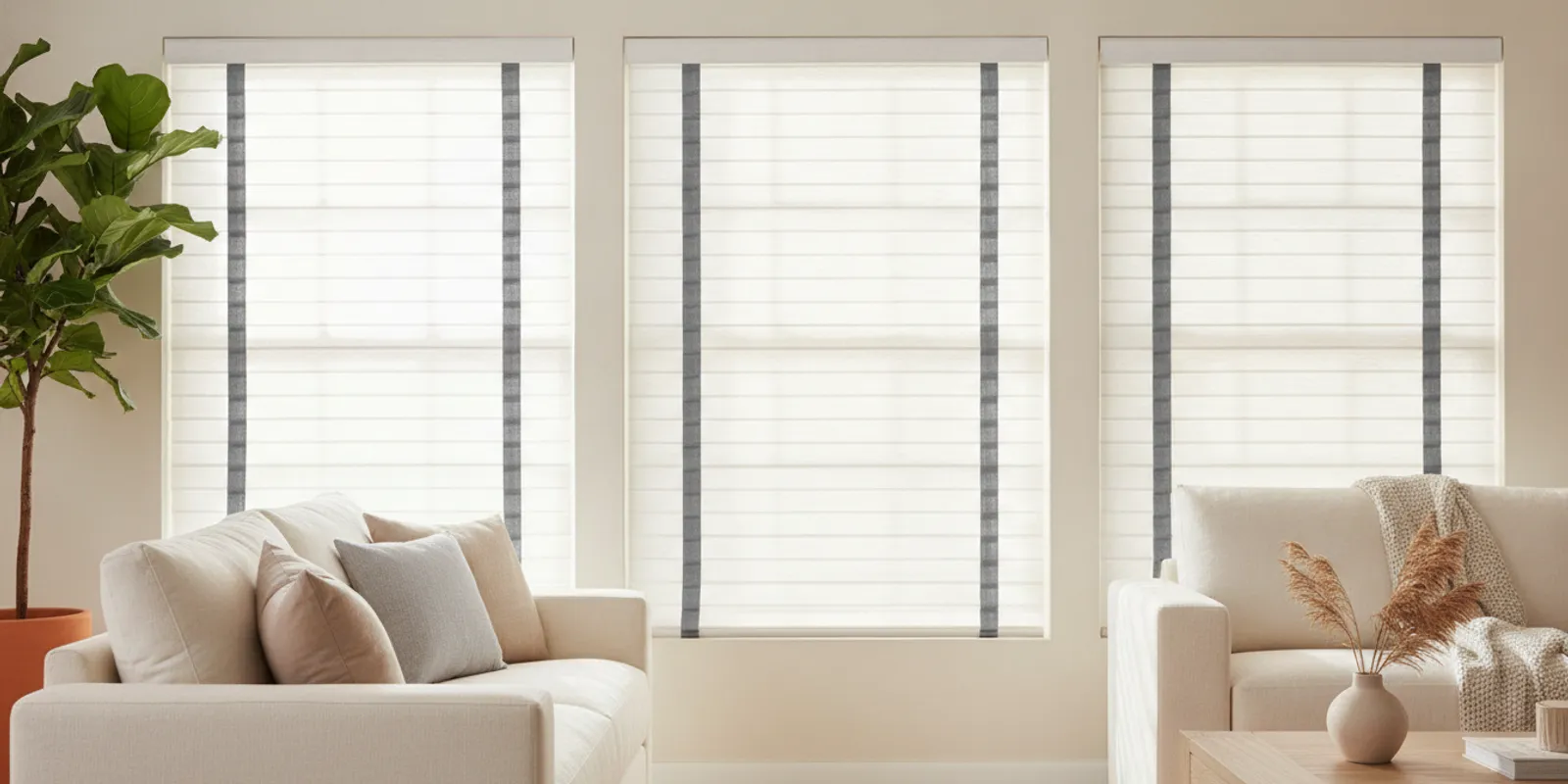
Vinyl faux wood blinds with cloth tape combine the familiar horizontal slat look with fabric strips that cover the ladder cords. The tapes can give a window a more finished, furniture-like appearance, but they also change how the blind looks when open and how you clean it. The right choice depends on the room, your style, and how much maintenance you want.
Call Vineyard Blind & Shutter at (951) 757-4188 to discuss custom blind options.
Q: Are vinyl faux wood blinds with cloth tape the right choice? A: They can be a good fit if you like the fabric bands and are comfortable caring for them. Cloth tape conceals the rout holes and ladder cords, but it is a design detail, not a different slat material or cordless safety feature. Compare a full-size sample in the room before deciding whether the added detail suits your space.
What are vinyl faux wood blinds with cloth tape?
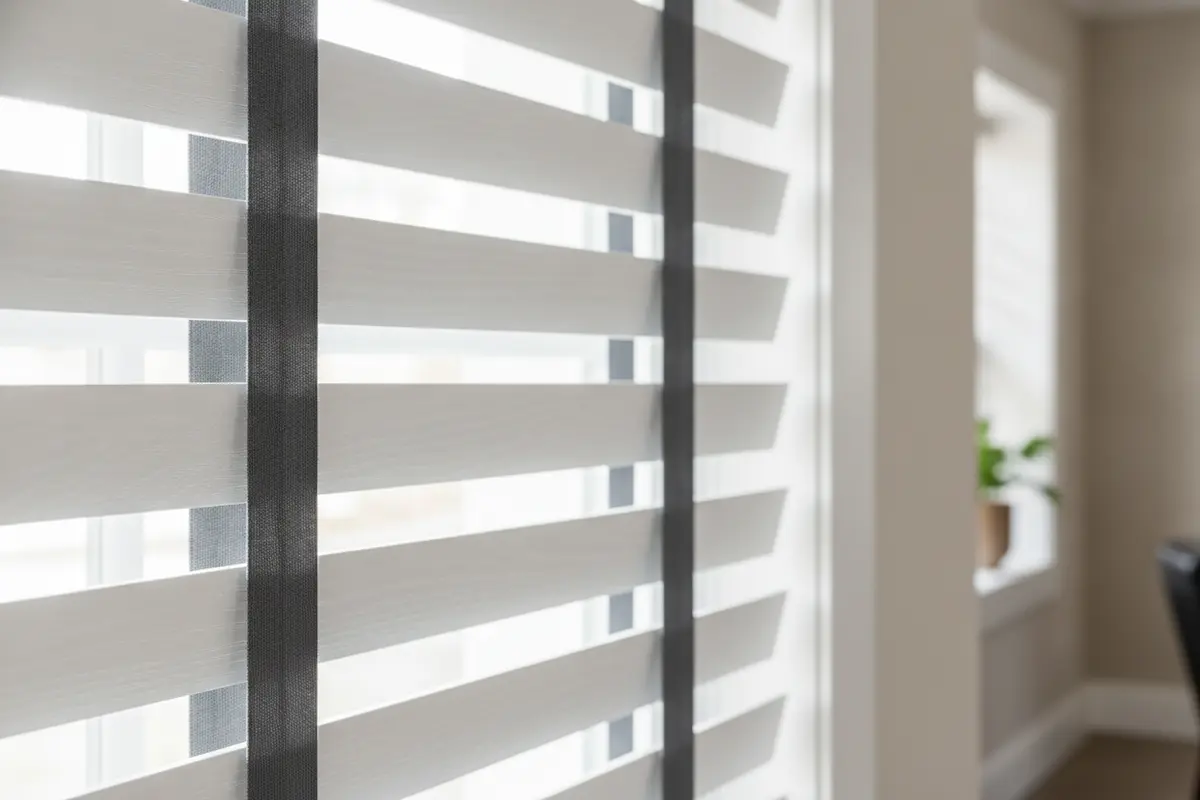
Faux wood blinds have horizontal slats designed to resemble painted or stained wood. The slats tilt to adjust incoming light and privacy, and lift to expose more of the window. In this style, vertical fabric tapes run down the face of the blind. They cover the cords or ladder strings that support and tilt the slats, creating a more decorative alternative to the small ladder-cord pattern visible on a standard blind.
“Vinyl” and “faux wood” are often used loosely in product descriptions, so confirm the actual material and construction of the specific blind being considered. Slat composition, finish, size, and operating hardware vary by product. Cloth tape is fabric, even when attached to a moisture-friendly slat material. It should not be treated as waterproof or assumed to have the same cleaning needs as the slats.
The tapes are usually available in colors chosen to coordinate with the slats, window trim, or room palette. A close match keeps the pattern subtle. A contrasting tape makes the blind more noticeable and can echo other fabric accents in the room. Width, placement, and color options differ, so ask to see the actual combinations available rather than relying on a small screen image.
How does cloth tape change the look?
Without fabric tape, the ladder cords make a narrow, repeating line across the slats. That look is simple and can blend into the blind, especially when the cords and slats are similar in color. Cloth tape replaces that fine line with broader vertical bands. The result can feel more tailored, decorative, or substantial, depending on the tape color and the rest of the room.
That added detail has trade-offs. A high-contrast tape draws the eye to the window. This can help a plain window feel intentional, but may compete with patterned upholstery, strong trim, or other focal points. A matching tape tends to read as quieter while still hiding the ladder openings. Neither approach is universally better: look at the window from across the room, not only at a close-up sample.
Consider the full window arrangement, too. The visible tape pattern repeats across every slat and is more noticeable when the blind is lowered. When the slats are tilted open, the tapes remain visible but the changing slat angles alter the overall impression. If you plan to pair the blind with curtains or a valance, check that the tapes do not make the top treatment look overly busy.
One practical method is to compare a taped sample and a standard ladder-cord sample against the actual trim and nearby fabrics. View them in morning and afternoon light. If the tape seems too strong in daylight, it is likely to remain a prominent design feature rather than disappear into the room.
How do the two styles compare?
Both versions provide horizontal slat tilt and lift. The central difference is the visible ladder treatment, but that difference can affect the visual feel, cleaning routine, and purchase choices. Use the comparison as a starting point; specifications and operating options vary by manufacturer and product.
| Feature | Cloth-tape faux wood blind | Standard ladder-cord faux wood blind |
|---|---|---|
| Appearance | Fabric bands cover the ladder cords and rout holes; color can coordinate or contrast. | Narrow cords create a simpler, less prominent pattern. |
| Light and privacy | Tilting slats manage view and incoming light; tape does not make the blind blackout. | Slat tilt provides similar basic light and privacy adjustment. |
| Cleaning | Dust slats and handle the fabric carefully according to product instructions. | Fewer fabric surfaces; dust slats and cords as directed. |
| Design emphasis | More visible texture and vertical accents at the window. | Quieter look that keeps attention on the slats or surrounding decor. |
| Planning cost | Custom faux wood blinds are often planned in a broad range such as $250 - $600 per window; tape, size, options, and installation affect the quote. | Use the same broad planning range for custom blinds; compare actual like-for-like quotes rather than assuming cords always cost less. |
The cost range is a rough planning guide, not a quote or a guarantee for any specific window. Window dimensions, material, controls, color, number of blinds, and installation conditions all affect the final price. Ask for a written quote that identifies the product and options, so you can compare equivalent configurations. You can also browse the company’s window treatment gallery to consider how different styles read in finished rooms.
It helps to separate appearance from function when comparing the two versions. A fabric tape may make the blind look more finished, but it does not strengthen a slat, improve the headrail, or change the way the control mechanism works. Ask whether the tape is part of the standard configuration or an added option, and whether choosing it changes the available colors or lead time. Those details can vary across product lines. If one quote includes cloth tape and another does not, compare the specifications before comparing totals.
Also consider how often you raise the blind. A frequently used window puts more attention on the controls and the blind’s clearance, while a fixed view window may emphasize the look of the lowered slats. Ask to operate a sample if one is available. Check that you can reach the controls, that the blind clears the sill as expected, and that the tape pattern still appeals when the slats are tilted and raised.
Will cloth tape change light control or privacy?
Light and privacy are controlled mainly by the slats, their fit, and their tilt—not by the fabric strips. Turned one way, the slats can direct daylight upward or downward while limiting a direct view. Tilted more closed, they reduce the view through the blind, though small gaps and edge light can remain. Raised, the blind exposes more glass and gives a clearer view outside.
Cloth tape can cover the openings at the ladder route, which changes what you see through those particular points. It does not turn a slatted blind into a continuous shade, seal the sides of the window, or promise a dark room. If a bedroom needs stronger light blocking, discuss a different treatment or a complementary layer instead of assuming tape provides it. Compare other custom shade options when continuous coverage is a priority.
For privacy, assess the room from the outside at the time it will be used. Daylight can make a window behave differently from an illuminated room at night. Check the blind at several slat angles, and consider how close neighbors, street views, and the window’s height affect the result. The tape color does not change these basic viewing conditions.
Are cloth-tape blinds a good choice for kitchens and bathrooms?
Faux wood styles are often considered for rooms where real wood may be less practical, but material names alone do not establish that a particular blind is suitable for every damp or wet location. Verify the product’s moisture guidance with the manufacturer or retailer. Also consider the fabric tapes: they can collect cooking residue or be more affected by frequent condensation than smooth slats.
In a kitchen, note the blind’s distance from the cooktop, sink, and areas where grease or splashes are likely. In a bathroom, consider ventilation, window placement, and whether the blind is exposed to direct water. Do not assume cloth tape is washable or that the complete assembly can be soaked. If regular exposure is likely, ask about a simpler ladder treatment or another window covering designed for the conditions.
For a nursery or child’s room, decide on the operating system separately from the appearance. Cloth tape covers ladder cords, but it does not by itself mean the blind is cordless. Confirm exactly how the blind is raised and tilted, and ask about available cordless configurations if that is important to your household. The U.S. Consumer Product Safety Commission is a place to review current consumer product safety information; check its official website and the product’s own instructions.
What should you expect when cleaning them?
Dusting is straightforward when done regularly, but the fabric tapes add a surface that deserves deliberate care. Close the slats in one direction and remove loose dust with a soft cloth, duster, or vacuum attachment on a gentle setting if the product instructions allow it. Then tilt the slats the other way to reach the opposite faces. Support the slats rather than pulling on the tapes.
Work gently around the fabric. A soft brush can help lift dry dust, but rubbing hard may distort a tape or move debris into the weave. Avoid spraying cleaner directly onto a cloth tape. If a mark appears, check the manufacturer’s care directions before spot cleaning; water, detergent, or stain removers may leave rings, change the color, or damage the fabric. A microfiber cloth lightly dampened for the slats may be suitable for some products, but follow the specific instructions.
Frequency depends on the room. A blind near a busy kitchen may need attention more often than one in a guest room. Routine dusting is easier than waiting until residue builds up. During cleaning, look for loose fittings, a slat that no longer tilts evenly, or a tape that has shifted. Stop if a part appears damaged and ask the provider what repair or adjustment is appropriate.
How should you choose tape color and slat finish?
Start with the window trim and the largest fixed finishes in the room. A white slat with white tape blends with light trim. A warm neutral tape can relate to wood flooring or woven textures, while a dark tape can echo hardware or furniture. Matching every finish is not necessary; the goal is to decide whether the blind should recede or act as a visual accent.
Look at a sample beside the wall color, trim, and nearby upholstery. A tape that looks beige in a showroom may read gray or yellow in your room. Slat color also changes with natural and artificial light. If coordinating with curtains, compare the materials together and leave room for differences in texture; fabric tape does not have to match curtain fabric exactly to look intentional.
Next, consider the width and number of slats in relation to the window. A larger window can make a repeated pattern more prominent. For multiple windows in one room, consistent tape and finish usually create a calmer effect, but individual window shapes and trim may influence the best configuration. Photograph the sample in place at different times of day and review the whole wall, not only the sample itself.
What measurements and fit details matter?
Custom blinds depend on accurate measurements and decisions about how the blind will sit in or around the window opening. An inside mount sits within the frame and requires enough depth and clearance for the headrail and slats. An outside mount covers the opening and may extend beyond the trim to reduce uncovered edges. Neither mount is automatically right for every frame.
- Check whether the frame is square and whether trim, handles, or cranks interfere with the slats.
- Consider how much glass should remain uncovered when the blind is raised.
- Identify nearby doors, furniture, or radiators that could obstruct the lift or tilt controls.
- Decide whether multiple windows should align at the top or be measured individually.
- Confirm the chosen tape, slat finish, and operating controls on the written product specification.
Measure each window separately rather than assuming a group is identical. Small differences in width or height can affect fit and appearance. If you are unsure which mount or measurement convention applies, do not order based on a guess. Vineyard’s mobile window treatment service brings samples to the home, where color and proportion can be considered in the actual room. The company provides free measurements and free installation.
Think about the window’s shape and surroundings as well as its dimensions. Deep sills can provide room for an inside mount, while shallow or uneven frames may call for another approach. Handles, locks, and nearby trim can limit how far slats tilt or how the headrail fits. With an outside mount, the chosen overlap affects how much trim remains visible and how the blind relates to neighboring windows. These are useful details to flag before final measurements.
For a group of windows, decide whether matching appearance or each window’s individual function matters most. A consistent tape color can create a coordinated wall, yet a frequently opened window may need a control arrangement that is not practical for a less-used one. You can keep a common slat and tape finish while confirming operating details window by window. Record those decisions with the measurements so there is no ambiguity when the order is placed.
When should you choose cloth tape, and when should you skip it?
Choose cloth tape when you like its decorative bands, want to conceal the ladder openings, and are comfortable caring for fabric details. It can suit a room where the blind is visible and its finish is part of the design. It is also worth considering when you have found a tape color that relates naturally to the trim or other furnishings.
Choose a standard ladder-cord style when you prefer the least noticeable hardware, want to keep the design visually simple, or would rather avoid fabric surfaces in a room that gathers grease or moisture. A different treatment may be better when you want broad, continuous light coverage or when the particular window’s shape or use makes a slatted blind inconvenient.
There is no need to pick based only on a product photo. Compare operating the blind, viewing it from the room and outside, and seeing a full-width sample if available. For broader product comparisons, review the company’s pages on custom blinds and window covering products. If you would like help sorting through choices, use the contact page to arrange a conversation.
What questions should you ask before ordering?
Before committing, ask for details that make the options easy to compare:
- What is the exact slat material, finish, and available size for this product?
- Which tape colors and widths are available, and can I see a sample in the room?
- What are the care instructions for both the slats and the tape?
- Is this product approved for the window’s moisture and temperature conditions?
- What operating systems are available, and is the selected one cordless or corded?
- How will the mount affect clearance, visible glass, and the blind when raised?
- Does the quote include measurement, installation, and all selected options?
Ask to have the configuration written down, especially if comparing multiple quotes. The product name alone may not identify the material, controls, tape color, or mounting details. The frequently asked questions page may also help you prepare for a product discussion.
Before deciding, write down what matters most for this particular room: a quiet appearance, an accent detail, easy dusting, privacy at certain hours, or compatibility with nearby furnishings. Rank the priorities rather than expecting one blind to solve every concern. Then compare two or three configurations against the same window and use case. A clear shortlist makes an in-home discussion more useful and helps keep the final order aligned with the reasons you chose cloth tape in the first place.
Cloth tape is best viewed as a visible design choice with its own care considerations, while light control, fit, and operation depend on the complete blind. Compare real samples, confirm the material and controls, and choose the style that suits the room’s daily use.
Call Vineyard Blind & Shutter at (951) 757-4188 to talk through blind styles and measurements.